measurement uncertainty

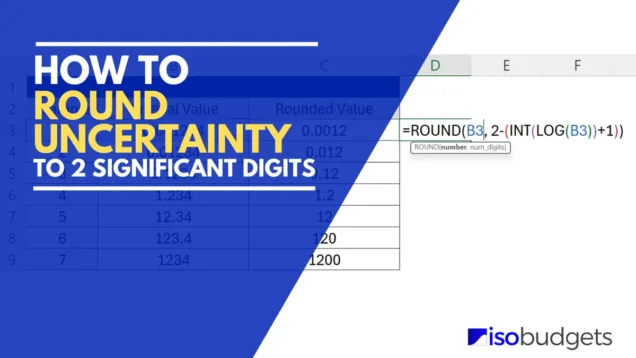
  • Rounding Uncertainty Guide Cover Image with Formula

    How to Round Uncertainty to 2 Significant Digits (ISO 17025)

      Key Takeaways: Rounding Uncertainty & Results The 2-Digit Rule: Per JCGM 100:2008 (GUM) and ILAC P14, expanded uncertainties must be reported to a maximum of two significant digits. Consistency Requirement: Measurement results must be rounded to match the final decimal place of the rounded uncertainty to avoid audit nonconformities. Core Rounding Methods: Laboratories typically […]
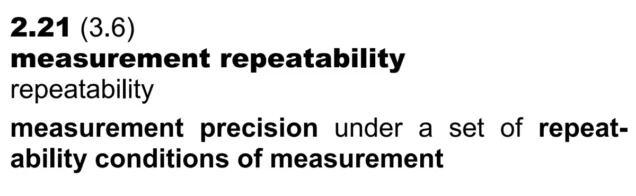
  • Measurement repeatability definition from JCGM 200:2012 (VIM)

    What is Measurement Repeatability

    Short Answer: Measurement repeatability is a statistical evaluation of variability in replicate measurement results on the same or similar object over a short period of time under the same measurement conditions, including the same procedure, operators, measuring system, operating conditions and location.     Official VIM Definitions Related to Measurement Repeatability   Measurement Repeatability According […]

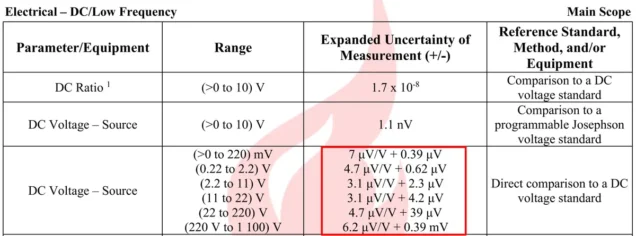
  • CMC Uncertainty Example - Function per ILAC P14

    What is CMC Uncertainty

    Short answer: According to the proceedings from the 96th meeting of the CIPM (2007), CMC uncertainty is a calibration and measurement capability available to customers under normal conditions: As published in the BIPM key comparison database (KCDB) of the CIPM MRA or as described in the laboratory’s scope of accreditation granted by an ILAC-MRA signatory. […]

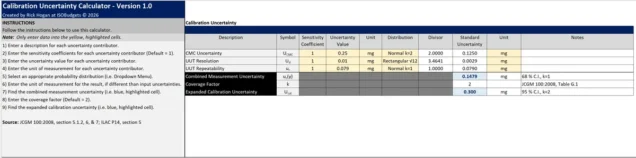
  • ISOBudgets ILAC P14 Calibration Uncertainty Calculator Version 1,0 - Free

    How to Calculate Calibration Uncertainty

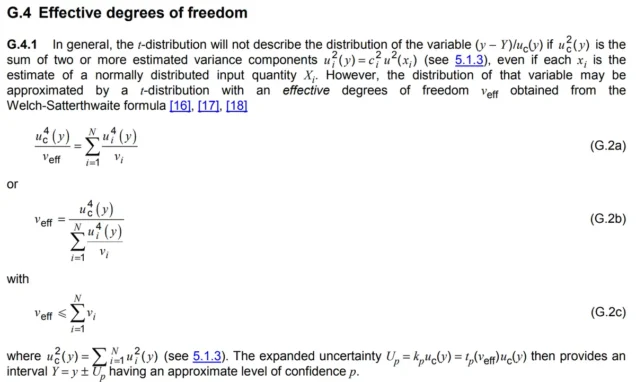
    Short answer: Calibration uncertainty is calculated by combining the CMC uncertainty, UUT resolution, and UUT repeatability using the square root of the sum of squares (RSS) method per the JCGM 100:2008 section 5.1.2 and ILAC P14 section 5.3. The combined uncertainty is expanded to a 95.45 % confidence interval using an appropriate coverage factor (k), […]

  • What is Calibration Uncertainty

    Short answer: Calibration uncertainty is the measurement uncertainty expressed in calibration reports at a 95 % confidence interval, where k=2, with two significant digits. It is calculated by combining the laboratory’s CMC uncertainty with the Unit Under Test (UUT) resolution and repeatability per ILAC P14.     Calibration Uncertainty Reporting Requirements Per ILAC P14 Section […]

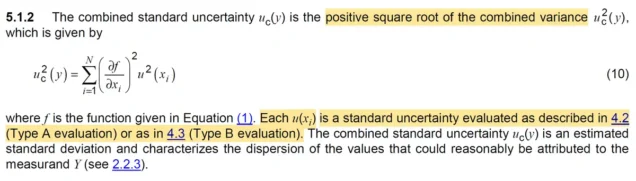
  • How do you combine multiple sources to get the combined standard uncertainty

    Short answer: Convert each source of uncertainty to a standard uncertainty (i.e. standard deviation) and combine them using the square root of the sum of squares formula (known as the RSS method) per section 5 of the JCGM 100:2008. According to the JCGM 100:2008 section 5.1.2, the “combined standard uncertainty is the positive square root […]

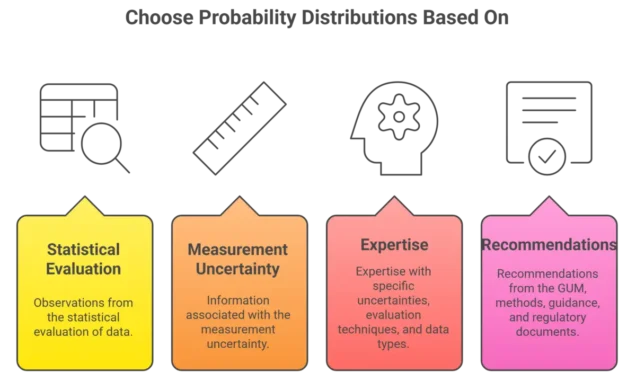
  • Choose Probability Distribution Diagram

    Why are some uncertainties assumed to be normally distributed while others are not

    Short Answer: Some uncertainties are assumed to be normally distributed based on: Observations from the statistical evaluation of data, Information associated with the measurement uncertainty, Expertise with specific uncertainties, evaluation techniques, and data types, or Recommendations from the GUM, methods, guidance, and regulatory documents. If a normal distribution is not appropriate, then another probability distribution […]

  • GUM Recommendations Choose Right Probability Distribution Chart

    How do you choose the right probability distribution for uncertainty (normal, rectangular, triangular)

    Short Answer: To choose the right probability distribution for each source of uncertainty, refer to sections 4.2 and 4.3 of the JCGM 100:2008. It includes criteria-based recommendations for selecting the right probability distributions. Otherwise, use a histogram, expertise, or published studies to find the right probability distribution.  Probability Distribution Recommendations from the GUM (JCGM 100:2008) […]