
Key Takeaways: Rounding Uncertainty & Results
- The 2-Digit Rule: Per JCGM 100:2008 (GUM) and ILAC P14, expanded uncertainties must be reported to a maximum of two significant digits.
- Consistency Requirement: Measurement results must be rounded to match the final decimal place of the rounded uncertainty to avoid audit nonconformities.
- Core Rounding Methods: Laboratories typically employ either Conventional Rounding (most common), Rounding Up, or Rounding to the Nearest Even Digit (Banker’s rounding).
- Common Error Source: Reporting excessive digits is a frequent trigger for external assessment deficiencies; “common sense” should guide the application of rules.
- Excel Automation: Formulas using nested log functions can completely automate compliant rounding for both uncertainties and reported values.
Introduction
Rounding uncertainty to two significant digits is a problem for many labs. According to the JCGM 100:2008 and(or) ILAC P14, accredited laboratory’s are required to round their results and uncertainties. However, there are plenty of labs that do not which leads to nonconformities cited during external assessments.
In this guide, you will learn the following:
- How to Round Uncertainty to 2 Significant Digits
- The Official Rules for Rounding Results and their Uncertainties
- Common Methods Used for Rounding
- How to Automatically Round Uncertainties and Results in MS Excel.
After reading this guide, you should be able to easily implement the proper techniques to round your reported uncertainties and results to avoid any future nonconformities.
Round Uncertainty to 2 Significant Digits
Round uncertainties to 2 significant digits following these instructions.
- Review the uncertainty value.
- Find the first non-zero number (First significant digit).
- Find the second significant digit (next number right of the first non-zero number).
- Find the third significant digit (next number right of the second significant digit).
- Round the second significant digit based on selected rounding rules.
The key is finding the first non-zero number. If you find the first significant digit, the rest of the process is easy.
What are Significant Digits and How to Find Them
According to the Oxford Advanced Learner’s Dictionary, significant digits are the digits of a number that are used to express it to the required degree of accuracy, starting from the first nonzero digit.
This is why you must focus on finding the first non-zero digit.
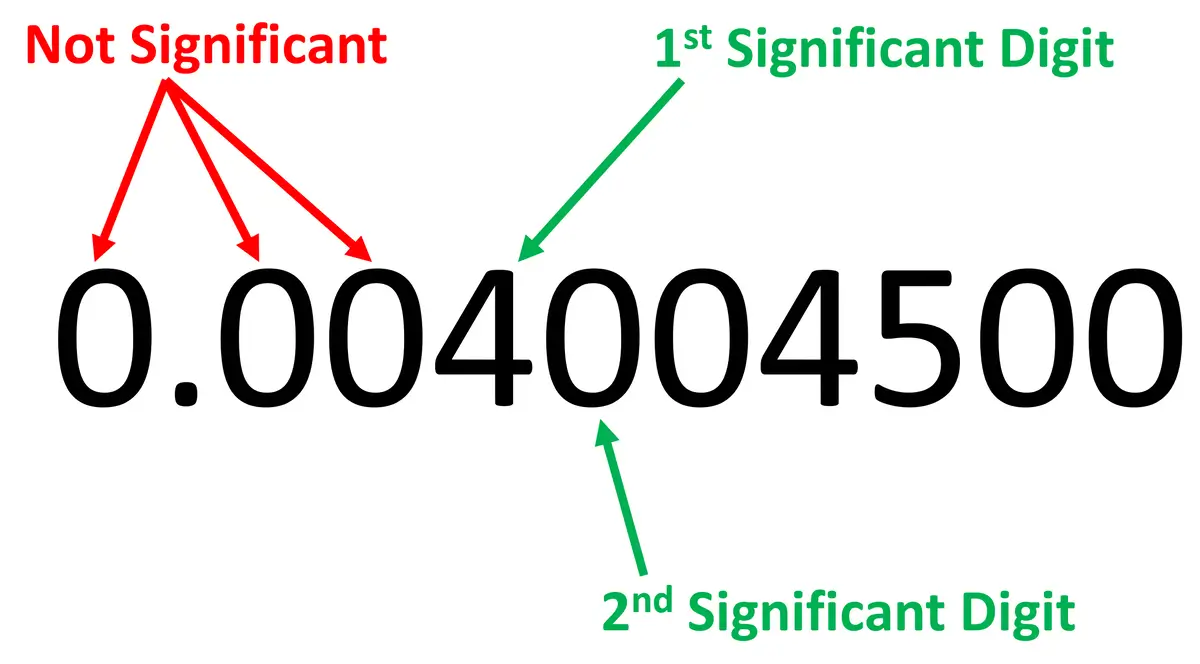
In the image below, you will see a number where I have labeled the first and second significant digits. Look at the image and notice the following observations:
- Leading zeros before the first non-zero digit are not significant.
- First non-zero digit is significant.
- All numbers to the right (including zeros) of the first non-zero digit are significant.
If you can find the first non-zero digit, you can easily round to two significant digits and avoid nonconformities.
Rules for Rounding Uncertainty
According to JCGM 100:2008 and, where applicable, ILAC P14, accredited laboratories must:
- Round their reported uncertainties to two significant digits, and
- Round the associated results so they are consistent with the reported uncertainties.
Otherwise, the laboratory is likely to be cited a nonconformity during an external assessment.
Reporting too many significant digits is a common nonconformity cited during assessments.
- More Common (Higher Risk): Assessors citing nonconformities for giving too many digits in the reported uncertainty.
- Less Common: Assessors citing nonconformities for giving too many digits in the reported report.
ILAC P14 Rounding Requirements
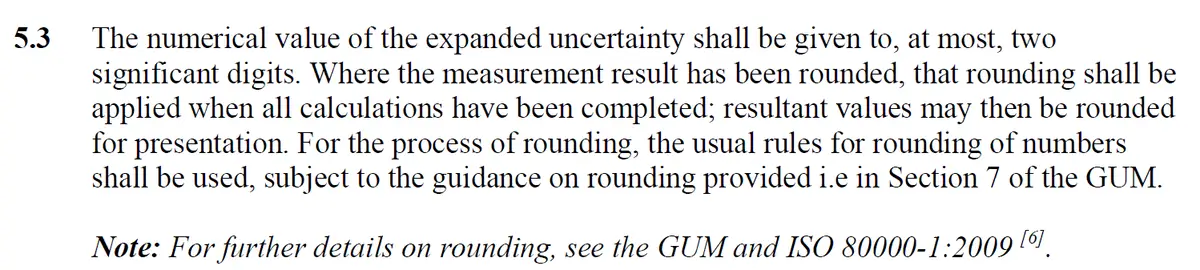
The statement below is published in the ILAC P14, section 5.3.
“The numerical value of the expanded uncertainty shall be given to, at most, two significant digits. Where the measurement result has been rounded, that rounding shall be applied when all calculations have been completed; resultant values may then be rounded for presentation. For the process of rounding, the usual rules for rounding of numbers shall be used, subject to the guidance on rounding provided i.e. in Section 7 of the GUM.”
JCGM 100:2008 Rounding Requirements
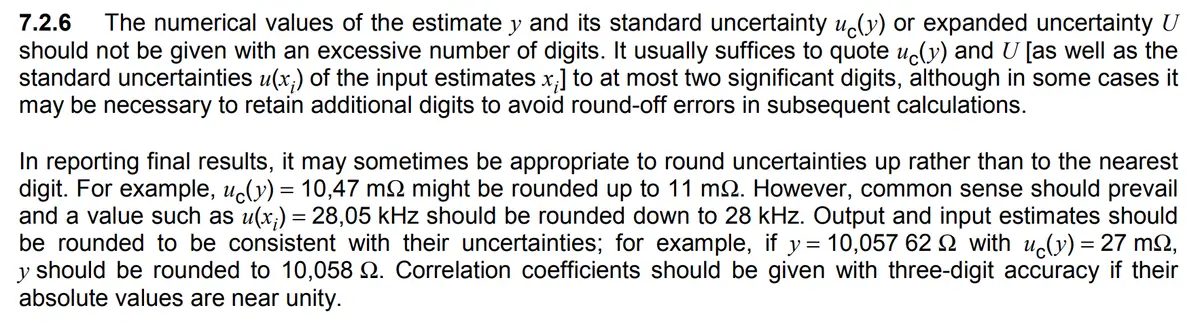
The statement below is published in the JCGM 100:2008, Section 7.2.6.
“The numerical values of the estimate y and its standard uncertainty uc(y) or expanded uncertainty U should not be given with an excessive number of digits. It usually suffices to quote uc(y) and U [as well as the standard uncertainties u(xi) of the input estimates xi] to at most two significant digits, although in some cases it may be necessary to retain additional digits to avoid round-off errors in subsequent calculations.
In reporting final results, it may sometimes be appropriate to round uncertainties up rather than to the nearest digit. For example, uc(y) = 10,47 mΩ might be rounded up to 11 mΩ. However, common sense should prevail and a value such as u(xi) = 28,05 kHz should be rounded down to 28 kHz. Output and input estimates should be rounded to be consistent with their uncertainties; for example, if y = 10,057 62 Ω with uc(y) = 27 mΩ, y should be rounded to 10,058 Ω. Correlation coefficients should be given with three-digit accuracy if their absolute values are near unity.”
For many years, assessors interpreted this clause as “uncertainties must be rounded up.” However, in 2013, the second revision of the ILAC P14 highlighted part of the JCGM 100:2008, section 7.2.6 that many overlooked, “common sense should prevail.” This made the use of conventional rounding acceptable and reduced the number of nonconformities cited for not rounding uncertainties up.
Acceptable Methods to Round Uncertainty
There are several methods that accredited laboratories can use to rounding uncertainties, including:
- Conventional Rounding,
- Rounding Up to the Next Digit, and
- Rounding to the Nearest Even Digit.
The most commonly used method is conventional rounding.
For years, assessors interpreting the JCGM 100 as recommending all uncertainties must be rounded up. However, in 2011, the ILAC P14 highlighted that the GUM stated that “common sense should prevail” opening the door for the acceptance of conventional rounding.
Method #1: Conventional Rounding
Always round to the nearest digit. (This is the most commonly used rounding method)
- Round Up: If the third significant digit is 5 or greater.
- Round Down: If the third significant digit is less than 5.
| 1.23 | Rounds to → 1.2 |
| 9.85 | Rounds to → 9.9 |
Note: This method is also referred to as simple rounding, round half-up, round half towards plus infinity, or asymmetric rounding. It is defined in ISO 80000-1, JCGM 100:2008, ASTM E29, NIST GLP9, NIST SP811, and DKD-L 13-3.
Method #2: Rounding Up
Always round up to the next largest value.
- Round Up: If the third significant digit is greater than zero.
| 1.23 | Rounds to → 1.3 |
| 9.83 | Rounds to → 9.9 |
Note: This method is also referred to as round up, round towards plus infinity, round away from zero, and round towards infinity. It is defined in JCGM 100:2008, ASTM E29, and NIST GLP9.
Method #3: Round to the Nearest Even Digit
Always round to the nearest even digit.
- Round Up: If the second significant digit is odd.
- Round Down: If the second significant digit is even.
| 1.23 | Rounds to → 1.2 |
| 9.83 | Rounds to → 9.8 |
Note: This method is also referred to as odd/even rounding, unbiased rounding, convergent rounding, statistician’s rounding, Dutch rounding, Gaussian rounding, banker’s rounding, or broken rounding. It is defined in IEEE 754, ASTM E29, and NIST GLP9.
Automatically Round Uncertainty in Excel
Automate rounding uncertainty in Microsoft Excel to avoid a common nonconformity.
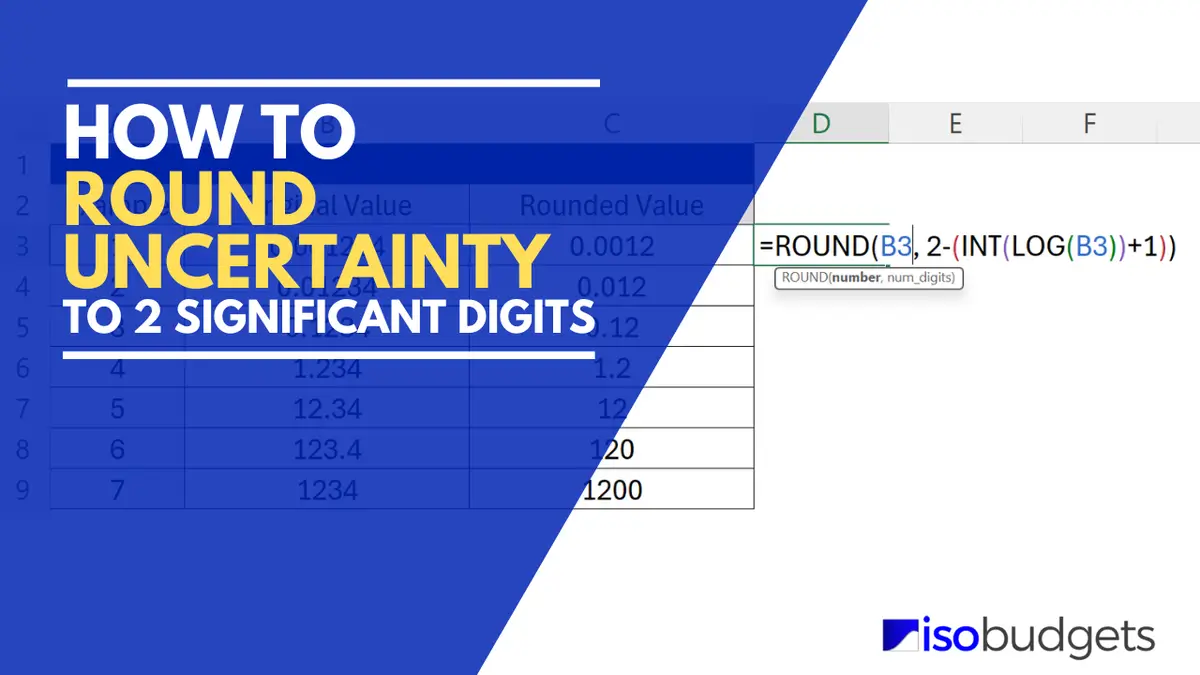
The formula below will round any reported uncertainty to two significant figures. Just copy and paste it into your spreadsheet and replace [Uncertainty] with the cell that contains your uncertainty.
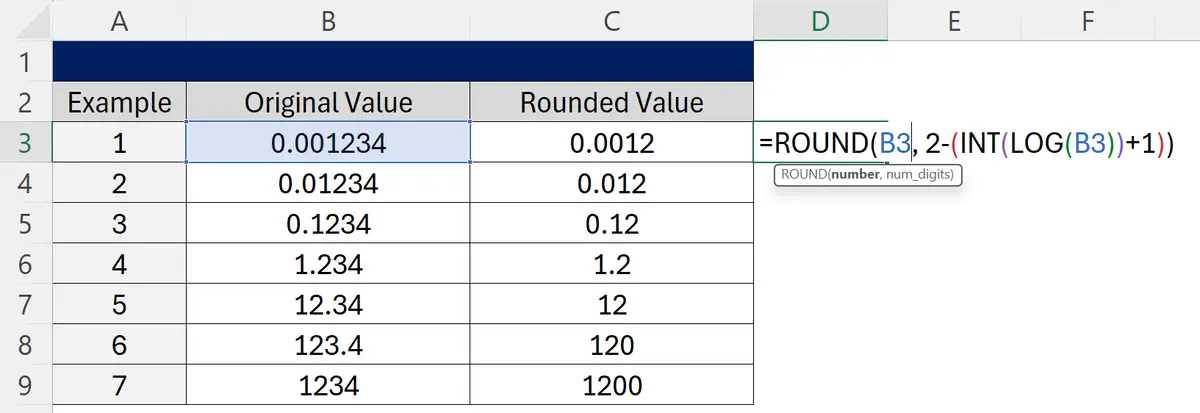
Round Results to be Consistent with Uncertainty
The JCGM 100 recommends rounding results so they are consistent with the reported uncertainty. The formula below automatically rounds results to the same number of digits as the reported uncertainty.
Just replace [Result] with the cell containing the reported result and replace [Uncertainty] with the cell that contains your uncertainty.
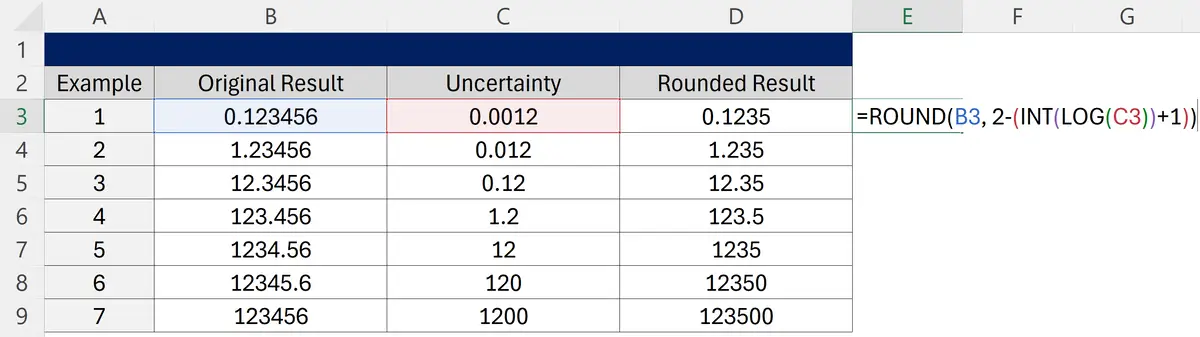
Implement these solutions and your reported results and associated uncertainties will comply with JCGM 100:2008 and ILAC P14.
Rounding Uncertainty Examples
The table below provides examples of various numbers rounded to two significant digits using conventional rounding.
| Category | Original | Rounded (2 digits) |
| Numbers Less than Zero | 0.000312 | 0.00031 |
| 0.00405 | 0.0041 | |
| 0.0553 | 0.055 | |
| 0.541 | 0.54 | |
| Numbers Greater than Zero | 1.03 | 1.0 |
| 10.7 | 11 | |
| 102 | 100 | |
| 1035 | 1000 | |
| 10634 | 11000 |
Note: Rounded using conventional rounding method.
FAQ: Frequently Asked Questions
Do you always round uncertainties up?
No, you do not always round uncertainties up. The JCGM 100:2008, Section 7.2.6 provides guidance for rounding uncertainties up (in some cases) rather than to the nearest digit. However, the guide states “common sense should prevail” when rounding uncertainties.
Therefore, you can use rounding methods, such as:
- Conventional Rounding,
- Rounding Up, or
- Round to the Nearest Even Digit (i.e. Odd/Even Rounding)
What is the rounding rule for uncertainty?
Report expanded uncertainty to, at most, two significant digits. Where necessary, round the uncertainty per guidance provided in Section 7 of the JCGM 100:2008 (GUM).
Additional guidance can be found in the following documents:
- ISO 80000-1,
- ASTM E29,
- NIST GLP9,
- NIST SP811, and
- DKD-L 13-3
What are significant digits?
Significant digits are the digits of a number used to express it to the required degree of accuracy, starting from the first nonzero digit.
How do I round off measurement uncertainty?
Round off measurement uncertainty following these instructions:
- Review the uncertainty value.
- Find the first non-zero number (First significant digit).
- Find the second significant digit (next number right of the first non-zero number).
- Find the third significant digit (next number right of the second significant digit).
- Round the second significant digit based on selected rounding rules.
Conclusion
Round reported uncertainties to two significant figures and results to the same number of digits in accordance with JCGM 100:2008, section 7.2.6. Otherwise, you risk getting a nonconformity during your next assessment. This is a common finding during ISO/IEC 17025 assessments.
Don’t leave your laboratory vulnerable to amending a bunch of nonconforming reports. Use this guide to understand the rules and methods for rounding uncertainties. Implement the formulas I use to automatically round uncertainty and results to meet ISO/IEC 17025 requirements and avoid nonconformities. Consider integrating these into your policies, procedures, and report templates to ensure this is effectively implemented in your laboratory.
Revision Note: This guide was originally published on August 3, 2013. It has been completely rewritten and updated to reflect current requirements under JCGM 100:2008 and ILAC P14, including updated conventional rounding acceptances and automated MS Excel implementation workflows.



2 comentarios