مقدمة
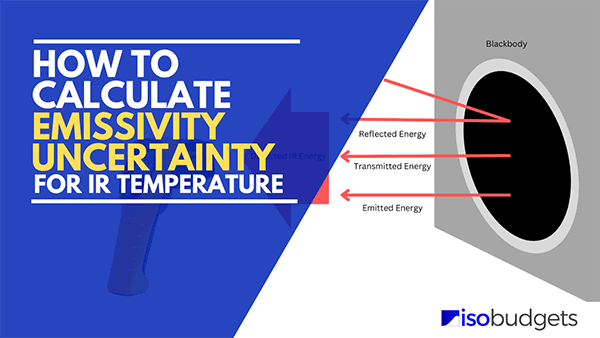
Emissivity is a source of uncertainty that affects IR temperature (i.e. radiation thermometry). It should be included in uncertainty budgets for blackbody calibrators and IR Thermometers. However, many ISO/IEC 17025 accredited laboratories have not included emissivity uncertainty in their budgets because their lab personnel did not know how to evaluate it. Furthermore, many experts, assessors, and accreditation bodies do a poor job of informing laboratories that:
- إنه مساهم مهم ينبغي إدراجه في ميزانيات عدم اليقين ، و
- ما هي الموارد المتاحة التي ينبغي للمختبرات استخدامها لتقييمها؟
This has led to a recent increasing trend in audit deficiencies related to not including emissivity uncertainty in the uncertainty analysis for IR temperature. So much so, that it made my list of top deficiencies (related to measurement uncertainty) cited last year.
In this guide, you will learn how to calculate emissivity uncertainty related to your infrared temperature measurements. With this information, you should be able to calculate the uncertainty caused by emissivity so you can:
- قم بتضمينها في ميزانيات عدم اليقين الخاصة بك، و/أو
- تصحيح قياسات درجة الحرارة الخاصة بك.
In either case, this is great information to know. Plus, this will work for both blackbody calibrators and infrared thermometers.
If you need to include this in your uncertainty budgets, keep reading. I am going to break down the process step by step and point you to professional resources that will back up the evaluation.
بالإضافة إلى ذلك، لقد قمت بإنشاء حاسبة عدم اليقين في الانبعاثية استنادًا إلى هذه الطريقة حتى تتمكن من تقدير عدم اليقين بشكل أسرع.
ما هي الانبعاثية
According to the National Physical Laboratory (NPL) in the UK, emissivity is defined as the ratio of the energy radiated from a material’s surface to that radiated from a perfect emitter, known as a blackbody, at the same temperature and wavelength and under the same viewing conditions. It is a dimensionless number between 0 (for a perfect reflector) and 1 (for a perfect emitter).
To simplify the above definition, emissivity is a ratio of the thermal radiation emitted by an object compared to a perfect blackbody (ε =1.0). Furthermore, the comparison should be made at the same temperature, wavelength, and viewing conditions.
In context to this guide, consider the emissivity of a blackbody calibrator surface used to perform infrared thermometer and pyrometer calibrations.
معادلة ساكوما-هاتوري
The Sakuma–Hattori equation is a mathematical formula for predicting the amount of thermal radiation, radiometric flux or radiometric power emitted from a blackbody or received by a thermal radiation detector.
In 2008, the BIPM CCT-WG5 (i.e. the radiation thermometry working group) recommended the Planckian form of the equation should be used to calibrate (or estimate emissivity uncertainty) for radiation thermometry below 961.8°C (i.e. silver point).
For infrared thermometers with wavelengths between 8 to 14 µm, the following equation and coefficients were recommended for temperatures between -40°C and 500°C.
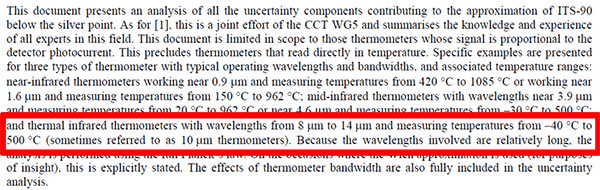
Be careful following ASTM E2758 and E2847. They both claim the formula and coefficients given below work for temperatures between -50°C to 1000°C. However, this is a mistake (as you can see in the above image).
Below, you will see the Sakuma–Hattori formula and coefficients for the IR temperature range with wavelengths between 8 to 14 µm.
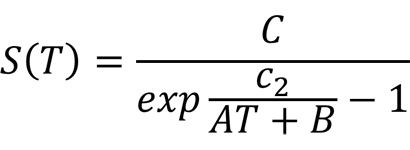
Where:
A – constant 9.364 µm for the 8 to 14 µm band
B – constant 178.4 µm for the 8 to 14 µm band
C – constant 1.0 µm for the 8 to 14 µm band
C2 – constant: 14387.752 µm · K
T – temperature (K)
S(T) – radiometric signal
تذكر هذه المعادلة. ستستخدمها في القسم التالي لتقييم عدم اليقين في الانبعاثية.
كيفية حساب عدم اليقين في الانبعاثية
حساب عدم اليقين في الانبعاثية ليس بالأمر السهل، إذ يتطلب سلسلة من العمليات الحسابية:
- صعب على معظم الناس، و
- تم شرحها بشكل سيء من قبل العديد من الخبراء ووثائق المعايير.
In my opinion, the ASTM E2847 and E2758 do a terrible job of explaining how to perform the calculation.
وبسبب هذا، يواجه العديد من الأشخاص صعوبة في تقدير عدم اليقين في الانبعاثية لمعايير الجسم الأسود ومقاييس الحرارة بالأشعة تحت الحمراء.
In this section, I am going to try to simplify the calculation of emissivity uncertainty by breaking down the process into easy to follow steps.
بشكل عام، تتكون العملية من الخطوات التالية:
- تحديد معلمات القياس
- احسب S(T) لمصدر الجسم الأسود
- احسب S(T) لدرجة الحرارة المنعكسة
- حساب عدم اليقين في الانبعاثية
- تحويل عدم اليقين في الانبعاثية إلى درجة الحرارة
في كل خطوة، ستحصل على تعليمات ومعلومات إضافية لمساعدتك على إكمال العملية.
However, if you have a difficult time trying to perform this calculation, just download our Emissivity Uncertainty Calculator. It will automatically perform all of the calculations for you.
انقر هنا لشراء حاسبة عدم اليقين في الانبعاثية
الآن دعونا نبدأ.
1. حدد معلمات القياس
لحساب عدم اليقين الناتج عن الانبعاثية، يجب أولًا تحديد معلمات القياس. وتشمل هذه:
- درجة حرارة السطح،
- درجة الحرارة المحيطة،
- انبعاثية السطح،
- انبعاثية الجهاز، و
- تقدير عدم اليقين في الانبعاثية
1.1. تحديد درجة حرارة السطح (عادةً مصدر الجسم الأسود)
In this step, you will specify the temperature of the surface that you are measuring. Typically, this is the surface or cavity temperature of a blackbody calibrator.
لذلك، قم بالإشارة إلى درجة حرارة سطح مصدر الجسم الأسود (على سبيل المثال 500 درجة مئوية).
1.2. تحديد درجة الحرارة المنعكسة (عادةً درجة الحرارة المحيطة)
Next, specify the reflected temperature. This is commonly the ambient temperature of the environment where the measurement is performed.
لذلك، قم بالإشارة إلى درجة الحرارة المحيطة بالبيئة (على سبيل المثال 23 درجة مئوية).
1.3. تحديد انبعاثية السطح
Now, find the emissivity of the blackbody surface that will be measured. Typically, the value will range between 0.94 and 0.995. You should be able to find this value in the manufacturer’s manual or datasheet.
In the image below, you will see the nominal emissivity of the Fluke 4180 and 4181 blackbody calibrators listed in the manufacturer’s datasheet.

1.4. تحديد انبعاثية الجهاز
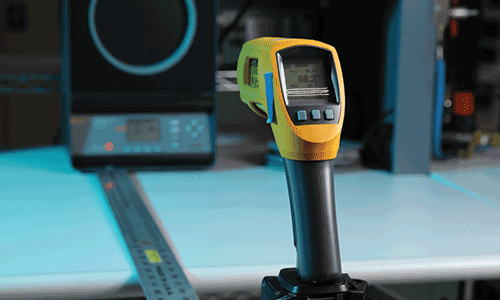
Next, find the emissivity of the instrument (e.g. IR Thermometer or Pyrometer) used to measure the blackbody surface. Typically, the value will range between 0.9 and 1.0.
You should be able to find this value in the instrument settings menu. Otherwise, you may need to refer to the manufacturer’s manual or datasheet.
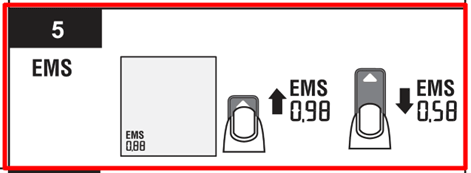
TIP: Some instruments can be adjusted to match the emissivity of the source in order to reduce emissivity uncertainty and errors.
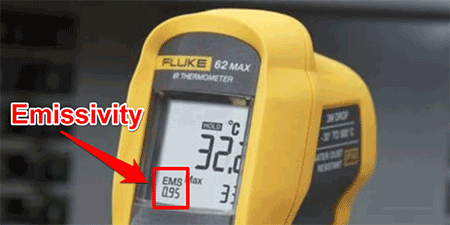
In the image below, you will see an excerpt from the Fluke 62 MAX IR Thermometer user guide showing you how to adjust the emissivity setting.
1.5. تحديد عدم اليقين المُقدّر في الانبعاثية (عادةً من 0.01 إلى 0.02)
Finally, estimate the value for emissivity uncertainty. Typically, the value ranges between 0.01 and 0.02. Many papers and application notes published by Fluke Calibration suggest an emissivity uncertainty of 1% of value. Therefore, an emissivity value of 0.95 would have an uncertainty of 0.0095 (i.e. 0.95 x 0.01 = 0.0095).
In the image below, you will see a graph (made by Fluke) that charts the effects of a 1% emissivity error vs temperature
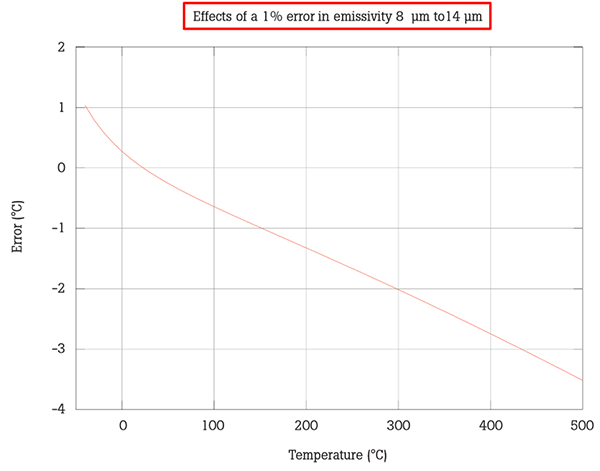
Alternatively, other documents suggest emissivity uncertainty values ranging from 0.01 to 0.02. In fact, ASTM E2847 gives an example that includes an expanded uncertainty of 0.02 for the emissivity of a blackbody surface.
2. احسب S(T) لمصدر الجسم الأسود باستخدام معادلة ساكوما-هاتوري
الآن بعد اكتمال الخطوة 1، احسب القيمة الإشعاعية S(T) لدرجة حرارة مصدر الجسم الأسود.
2.1. تحويل درجة حرارة الجسم الأسود إلى كلفن
أولاً، قم بتحويل درجة حرارة الجسم الأسود إلى كلفن.
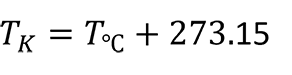
إذا كانت درجة حرارتك بالدرجات المئوية، فقم بتحويل درجة حرارتك إلى كلفن باتباع الإرشادات أدناه:
- أضف 273.15 إلى قيمة درجة الحرارة.
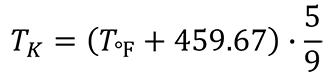
If your temperature is in degrees Fahrenheit, then convert your temperature to Kelvin by following the instructions below:
- أضف 459.67 إلى قيمة درجة الحرارة،
- اضرب نتيجة الخطوة 1 في 5،
- قسّم نتيجة الخطوة 2 على 9.
2.2 احسب القيمة الإشعاعية S(T) لمصدر الجسم الأسود
Next, use the Sakuma-Hatori equation to calculate the radiometric value S(T) for the blackbody source. You will need the values for constants A, B, C, and c2. These can be found at the beginning of this guide.
To calculate the radiometric value S(T), follow the steps below. They are given in the order of operations to calculate the result.
- اضرب الثابت A في درجة الحرارة بالكلفن.
- أضف الثابت B إلى النتيجة من الخطوة 1.
- قسّم الثابت c2 على النتيجة من الخطوة 2.
- استخدم الدالة الأسية لرفع e إلى قوة النتيجة من الخطوة 3.
- اطرح واحدًا (أي 1) من نتيجة الخطوة 4.
- وأخيرًا، قسّم الثابت C على نتيجة الخطوة 5.
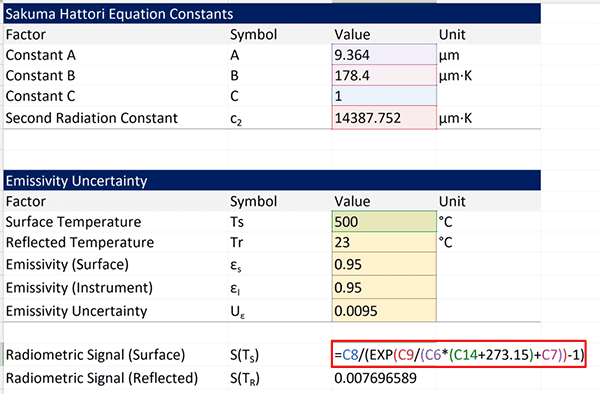
In the image below, you will see how this calculation is performed in Microsoft Excel. If you look at the function in the red rectangle, you will find the formula that matches the instructions above.
3. احسب S(T) لدرجة الحرارة المنعكسة باستخدام معادلة ساكوما-هاتوري.
Now that step 2 is complete, calculate the radiometric value S(T) for the reflected temperature. This will be the ambient temperature of the environment.
3.1. تحويل درجة الحرارة المنعكسة إلى كلفن
على غرار الخطوة 2.1، قم بتحويل درجة الحرارة المنعكسة (أي درجة الحرارة المحيطة) إلى كلفن.
3.2 احسب الإشارة الإشعاعية S(T) لدرجة الحرارة المنعكسة
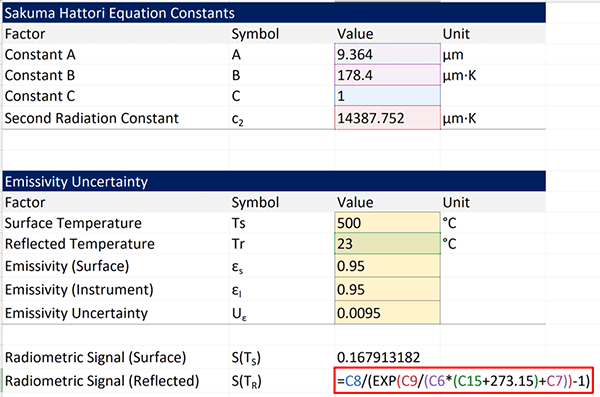
Next, use the Sakuma-Hatori equation to calculate the radiometric value S(T) for the reflected temperature. Similar to the Step 2.2, you will need the values for constants A, B, C, and c2 that can be found at this beginning of this guide.
Now, calculate the radiometric value S(T) following the steps below. They are given in the order of operations to calculate the result.
- اضرب الثابت A في درجة الحرارة بالكلفن.
- أضف الثابت B إلى النتيجة من الخطوة 1.
- قسّم الثابت c2 على النتيجة من الخطوة 2.
- استخدم الدالة الأسية لرفع e إلى قوة النتيجة من الخطوة 3.
- اطرح واحدًا (أي 1) من نتيجة الخطوة 4.
- وأخيرًا، قسّم الثابت C على نتيجة الخطوة 5.
In the image below, you will see how this calculation is performed in Microsoft Excel. If you look at the function in the red rectangle, you will find the formula that matches the instructions above.
4. احسب عدم اليقين في الانبعاثية
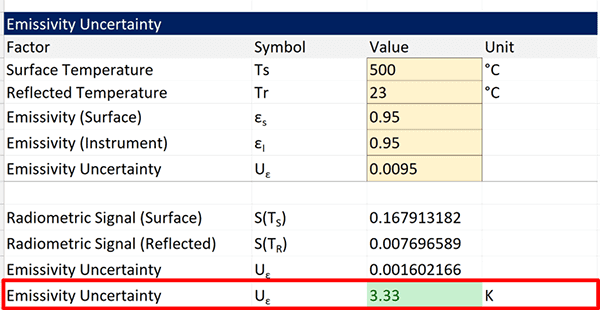
Now that you have the calculated radiometric signals S(T) for your blackbody source and ambient temperature, you can calculate the uncertainty due to emissivity.
فيما يلي، ستشاهد الصيغة الموصى بها من قبل ASTM E2847.

Where,
Uε = emissivity uncertainty
εS = emissivity of the source
εI = emissivity of the instrument
S(TS) = radiometric signal of the source temperature
S(TR) = radiometric signal of the reflected temperature
لحساب عدم اليقين الناتج عن الانبعاثية، اتبع التعليمات التالية. وهي مرتبة حسب العمليات الحسابية.
- اطرح انبعاثية المصدر من انبعاثية الجهاز.
- قسّم نتيجة الخطوة 1 على انبعاثية الجهاز.
- اطرح الإشارة الإشعاعية للمصدر من الإشارة الإشعاعية لدرجة الحرارة المنعكسة.
- اضرب نتيجة الخطوة 2 بنتيجة الخطوة 3.
The result is the emissivity uncertainty. However, it is a radiometric signal. So, you have to convert it to temperature units to add it to your uncertainty budgets.
5. تحويل عدم اليقين في الانبعاثية إلى درجة الحرارة
Finally, convert emissivity uncertainty radiometric signal to temperature in Kelvin. To do this, you will need to use the Sakuma-Hatori equation and solve for temperature.
يتطلب هذا العمل على خطوات المعادلة بشكل عكسي لحل درجة الحرارة.
I have already done this for you. Look at the equation below. It is the equation to convert emissivity uncertainty to temperature in Kelvin. Fluke Calibration has published a similar equation in some of their application notes and infographics. However, their formula has a mistake in it. Use the formula below instead.
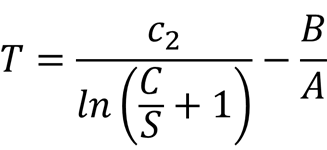
To convert the emissivity uncertainty to temperature in Kelvin, follow the instructions below. They are in order of mathematical operations.
- اقسم الثابت C على الإشارة الإشعاعية لمعرفة عدم اليقين في الانبعاثية.
- أضف واحدًا (أي 1) إلى نتيجة الخطوة 1.
- احسب اللوغاريتم الطبيعي لنتيجة الخطوة 2.
- قسّم الثابت c2 على نتيجة الخطوة 3.
- اقسم الثابت B على الثابت A.
- اطرح نتيجة الخطوة 4 من نتيجة الخطوة 5.
عند الانتهاء، سيكون لديك عدم يقين في الانبعاثية بالكلفن والذي يعادل درجات مئوية.
موارد لعدم اليقين في الانبعاثية
To evaluate uncertainty due to emissivity, it is good to have professional or scholarly resources to support your evaluations. In this section, you will see three great resources to support this guide and your calculations of emissivity uncertainty.
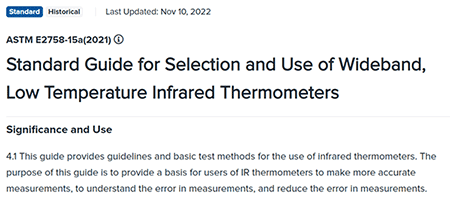
ASTM E2758
The ASTM E2758 is the most recommended method to evaluate emissivity uncertainties. It is referenced in more papers and documents than any other method. So, if you want a copy of the most referred resource, go to the ASTM website and purchase one for yourself.
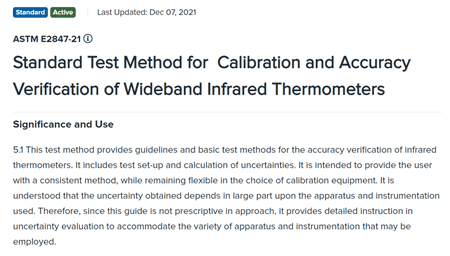
ASTM E2847
The ASTM E2847 is an alternative resource to ASTM E2758. It is not referenced or recommended as much, but it contains the same information. Additionally, it is a standard calibration method which may be beneficial if you are a calibration laboratory. You will get a calibration method (that does not need validation) and information on how to evaluate emissivity uncertainty.
ملاحظة تطبيق Fluke 4276605A_EN
Need a free resource? Download this application note from Fluke Calibration. It covers the same methodology in this guide to help you correct your IR temperature measurements for errors caused by emissivity.
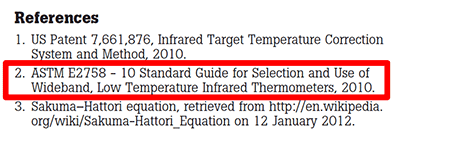
Regardless of what your assessor may say, you can use this method. It is based on ASTM E2758 and does not only apply to Fluke 4180 and 4181 infrared calibrators.
To back up my previous statement, you can see the references from the application note in the image below. It clearly gives a reference to ASTM E2758.
خاتمة
Emissivity uncertainty is a significant contributor to measurement uncertainty for infrared thermometer and pyrometer calibrations and measurements. Most accreditation bodies require laboratories to include emissivity in their uncertainty budgets. Even when it is not required, many assessors know it is a significant contributor and check to see if you included it in your uncertainty analysis.
As a result, this has led to an increase in the number of deficiencies cited in relation to emissivity missing in uncertainty budgets.
في هذا الدليل، يجب أن تكون قد تعلمت:
- ما هو تعريف الانبعاثية؟
- ما هي معادلة ساكوما هاتوري؟
- كيفية حساب عدم اليقين في الانبعاثية أو التصحيح.
With this information, you should be able to evaluate emissivity uncertainty for your infrared temperature uncertainty budgets. Give it a try and let me know if this guide has helped you.
إذا كنت لا ترغب في إنشاء الآلة الحاسبة الخاصة بك، فيمكنك شراء الآلة الحاسبة الخاصة بنا من خلال النقر على الزر أدناه.