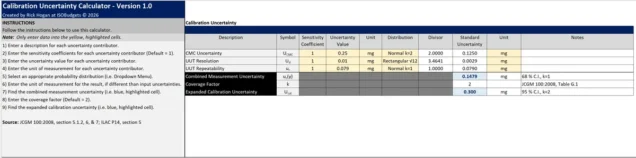
expanded uncertainty

  • ISOBudgets ILAC P14 Calibration Uncertainty Calculator Version 1,0 - Free

    How to Calculate Calibration Uncertainty

    Short answer: Calibration uncertainty is calculated by combining the CMC uncertainty, UUT resolution, and UUT repeatability using the square root of the sum of squares (RSS) method per the JCGM 100:2008 section 5.1.2 and ILAC P14 section 5.3. The combined uncertainty is expanded to a 95.45 % confidence interval using an appropriate coverage factor (k), […]

  • What is Calibration Uncertainty

    Short answer: Calibration uncertainty is the measurement uncertainty expressed in calibration reports at a 95 % confidence interval, where k=2, with two significant digits. It is calculated by combining the laboratory’s CMC uncertainty with the Unit Under Test (UUT) resolution and repeatability per ILAC P14.     Calibration Uncertainty Reporting Requirements Per ILAC P14 Section […]

  • Degrees of Freedom Formula for Type B Uncertainty per the JCGM 100:2008 section G.4

    What are degrees of freedom for Type B uncertainty

    Short answer: A Type B uncertainty evaluation typically has infinite (∞) degrees of freedom. However, the JCGM 100:2008 section G.4 recommends an alternative method to calculate the degrees of freedom for a Type B evaluation based on a scientific judgement about the reliability of the estimated uncertainty value.   νi = 1/2 · [δu(xi)/u(xi)]-2   […]

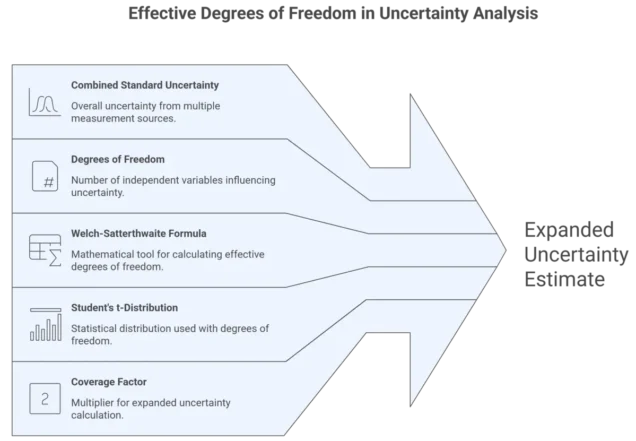
  • Effective Degrees of Freedom in Uncertainty Analysis Flowchart

    What is effective degrees of freedom

    Short answer: Effective degrees of freedom (υeff) is an approximation of the degrees of freedom associated with the combined standard uncertainty.  It is calculated using the Welch-Satterthwaite formula and used to quantify the reliability of the combined uncertainty estimate. According the JCGM 100:2008, it is calculated with the Welch-Satterthwaite formula and used with the Student’s […]

  • How to Determine Coverage Factor k Methods per JCGM 100:2008 Infographic

    How to determine coverage factor k

    Short Answer: Determine the coverage factor k using JCGM 100:2008 Table G.1 (normal distribution) for uncertainties that meet the conditions of the Central Limit Theorem and JCGM 100:2008 Table G.2 (t-distribution) when the conditions are not met.   Methods for Determining the Coverage Factor k According the the JCGM 100:2008 (GUM) Appendix G, there are […]

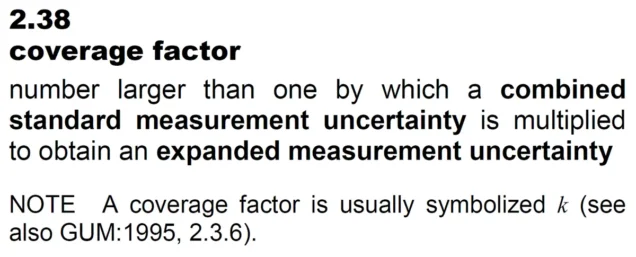
  • Coverage factor definition from JCGM 200:2012 section 2.38

    What is a coverage factor (k)

    Short Answer: A coverage factor is a multiplier that is used to expand measurement uncertainty to a desired level of confidence (e.g. 95 %).   Coverage Factor Definition per the VIM According to the JCGM 200:2012 (VIM – Vocabulary in Metrology), a coverage factor is a “number larger than one which a combined standard measurement […]

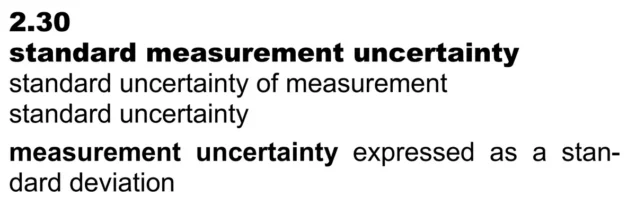
  • Standard Measurement Uncertainty Definition - JCGM 200:2012

    What is Standard Uncertainty

    Short answer: measurement uncertainty expressed as a standard deviation with a 68.27 % level of confidence. According to the Vocabulary in Metrology (VIM), standard measurement uncertainty is defined as “measurement uncertainty expressed as a standard deviation.”   FAQ How to calculate standard uncertainty? There are a few ways to calculate standard uncertainty. The two most […]

  • Common Methods to Calculate Standard Uncertainty Comparison Chart

    How to Calculate Standard Uncertainty

    Short answer: The two most common methods to calculate standard uncertainty are 1) calculate the standard deviation from a Type A uncertainty evaluation, or 2) convert an expanded uncertainty to a standard uncertainty. There are a few ways to calculate standard uncertainty. The two most common methods are: Calculate the standard deviation from a Type […]

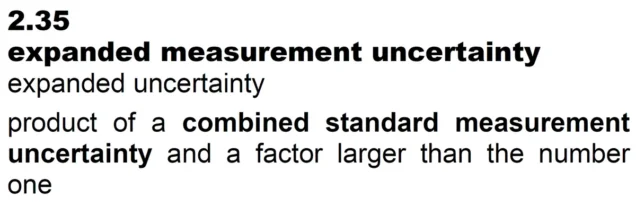
  • Expanded Measurement Uncertainty Definition - JCGM 200

    What is Expanded Uncertainty

    Short answer: The product of multiplying the combined standard measurement uncertainty (uc) multiplied by a coverage factor (k). According to the Vocabulary in Metrology (VIM), expanded measurement uncertainty is “the product of a combined standard measurement uncertainty and a factor larger than the number one.” (Source: JCGM 200:2012, 2.35) Measurement uncertainty is commonly expressed in […]

  • ISOBudgets Expanded Uncertainty Calculator - MS Excel

    How to Calculate Expanded Uncertainty

    Short answer: Multiply the combined standard measurement uncertainty (uc) by a coverage factor (k), where U = k x uc ISO/IEC 17025 accredited laboratories and ISO 17034 accredited producers calculate expanded uncertainty to a 95 % confidence interval where the coverage factor is two. The expanded uncertainty represents the interval y ± U which the […]