
There are a few ways to calculate standard uncertainty. The two most common methods are:
- Calculate the standard deviation from a Type A uncertainty evaluation
- Conversion from expanded uncertainty to standard uncertainty
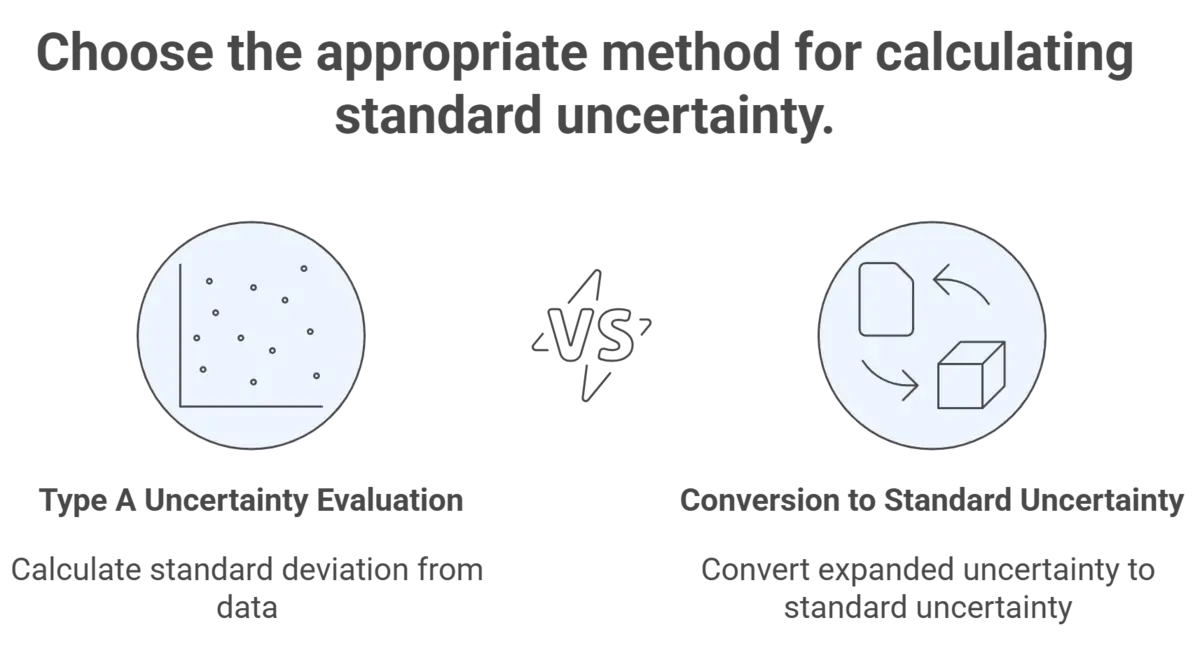
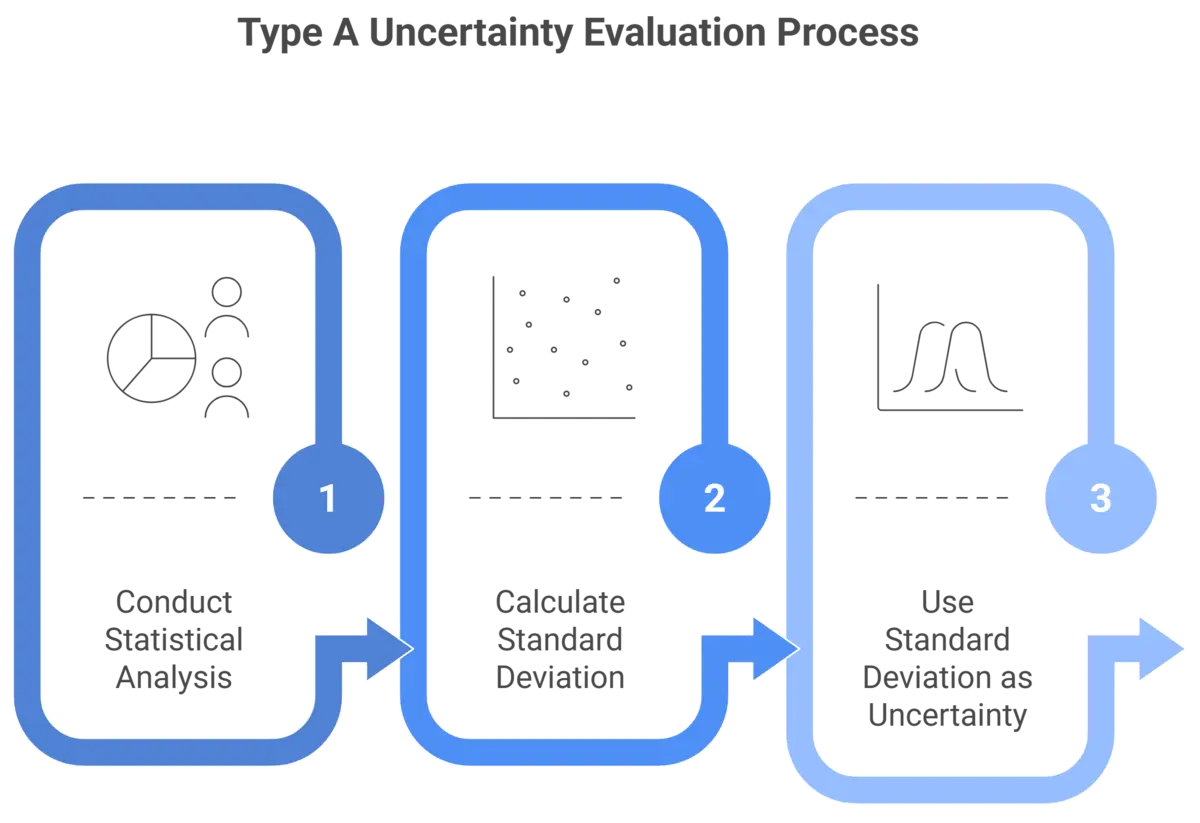
Method 1: Type A Uncertainty Evaluation
Evaluate uncertainty from Type A evaluations using analysis of variance (ANOVA) or other statistical methods. Most Type A evaluations result in a standard deviation (68 % level of confidence, where k=1) that may be used as a standard uncertainty – no further conversion needed.
Method 2: Conversion to Standard Uncertainty
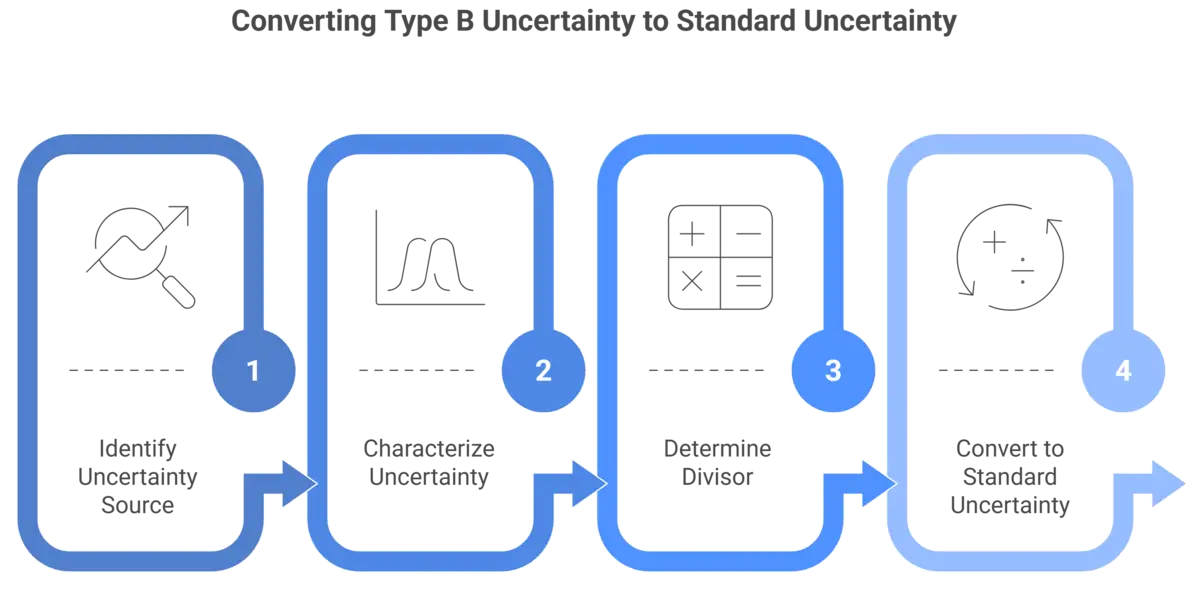
Some uncertainties, typically Type B uncertainties, need to be converted to a standard uncertainty (i.e standard deviation or standard deviation equivalent). Step-by-step instructions to convert these uncertainties is given below.
- Identify and quantify a source of uncertainty.
- Characterize the uncertainty – assign a probability distribution.
- Determine the divisor associated with the probability distribution.
- Convert to standard uncertainty – divide the uncertainty by the divisor
FAQ
What is standard uncertainty?
Measurement uncertainty expressed as a standard deviation with a 68.27 % level of confidence.
According to the Vocabulary in Metrology (VIM), standard measurement uncertainty is defined as “measurement uncertainty expressed as a standard deviation.”
How to convert to standard uncertainty?
Where applicable, convert expanded uncertainties to a standard uncertainty following the instructions below.
- Identify and quantify a source of uncertainty.
- Characterize the uncertainty – assign a probability distribution.
- Determine the divisor associated with the probability distribution.
- Convert to standard uncertainty – divide the uncertainty by the divisor
How to convert standard deviation to standard uncertainty?
Typically, a standard deviation does not need to be converted to a standard uncertainty because it is already expressed at a 68.27 % level of confidence. Otherwise, a standard deviation can be divided by a coverage factor of one, but this is typically meaningless.
What are examples of standard uncertainty?
Below, are some common examples of standard uncertainty.
Example 1: Repeatability and Reproducibility
Repeatability and reproducibility evaluations conducted in accordance with ISO 5725-2 and ISO 5725-3 will produce standard deviations that can be used as standard uncertainties.
Example 2: Drift Specification
Manufacturer drift specifications are typically considered an expanded uncertainty. They can be characterized with one of the following distributions:
- Normal distribution,
- Rectangular distribution, or
- Triangle distribution.
Based on the assigned distribution, the specification will be converted to a standard uncertainty by dividing its value by a divisor.
The specification will be converted to a standard uncertainty by dividing its value by a divisor associated with the assigned probability distribution.
Example 3: Calibration Uncertainty
Uncertainties from a calibration report are typically expressed to a 95 % confidence interval where k=2. The uncertainty is converted to a standard uncertainty by dividing it by its coverage factor k (i.e. 2).
Example 4: Instrument Resolution
Instrument resolutions are commonly characterized by a rectangular or half-rectangular distribution. The resolution value is converted to a standard uncertainty by dividing the resolution by an appropriate divisor (e.g. √3 or 2√3).
What is the difference between standard uncertainty and expanded uncertainty?
Standard uncertainty is a measurement uncertainty that has the same level of confidence as a standard deviation (e.g. 68.27 % C.I.).
An expanded uncertainty is a standard uncertainty multiplied by a coverage factor greater than one, so it has a level of confidence greater than a standard uncertainty (e.g. 95.45 % C.I.). However, expanded uncertainties can be expressed at other levels of confidence (e.g. 99 %, 99.73 %, or 100 % C.I.).
What is the difference between standard deviation and standard uncertainty?
A standard deviation can be a standard uncertainty, but a standard uncertainty may not be a standard deviation. Instead, it may be a standard deviation equivalent.
Typically, a standard deviation is determined using statistical techniques associated with Type A uncertainty evaluations.
However, a standard uncertainty can be determined with a Type B uncertainty evaluation where it may be converted from an expanded uncertainty to a standard deviation equivalent.
Sometimes, these conversions produce a standard deviation (e.g an expanded uncertainty with a Normal distribution where it is a multiple of a standard deviation per JCGM 100:2008 section 4.3.3).
Otherwise, the conversion results in a standard deviation equivalent (e.g. an uncertainty with a rectangular distribution divided by the square root of three per JCGM 100:2008 section 4.3.7).
Glossary
- Standard Measurement Uncertainty
- measurement uncertainty expressed as a standard deviation. (Source: JCGM 200:2012, 2.30)
- Standard Deviation
- a statistical measure quantifying the dispersion or spread (variation) of data points in a dataset relative to the mean (average), indicating how closely values cluster around the average
- Expanded Measurement Uncertainty
- the product of a combined standard measurement uncertainty and a factor larger than the number one. (Source: JCGM 200:2012, 2.35)
- Combined Standard Measurement Uncertainty
- standard measurement uncertainty that is obtained using the individual standard measurement uncertainties associated with the input quantities in a measurement model. (Source: JCGM 200:2012, 2.31)
- Coverage Factor
- number larger than one by which a combined standard measurement uncertainty is multiplied to obtain an expanded measurement uncertainty. (Source: JCGM 200:2012, 2.38)
- Type A Evaluation of Measurement Uncertainty
- evaluation of a component of measurement uncertainty by a statistical analysis of measured quantity values obtained under defined measurement conditions. (Source: JCGM 200:2012, 2.28)
- Type B Evaluation of Measurement Uncertainty
- evaluation of a component of measurement uncertainty determined by means other than a Type A evaluation of measurement uncertainty. (Source: JCGM 200:2012, 2.29)
- Measurement Repeatability
- measurement precision under a set of repeatability conditions of measurement (Source: JCGM 200:2012, 2.21)
- Measurement Reproducibility
- measurement precision under reproducibility conditions of measurement (Source: JCGM 200:2012, 2.25)
- Instrumental Drift
- continuous or incremental change over time in indication, due to changes in metrological properties of a measuring instrument (Source: JCGM 200:2012, 4.21)
- Instrumental Bias
- average of replicate indications minus a reference quantity value (Source: JCGM 200:2012, 4.20)
- Resolution
- smallest change in a quantity being measured that causes a perceptible change in the corresponding indication (Source: JCGM 200:2012, 4.14)
- Level of Confidence
- the likelihood that a set of measurement values are contained within a specified coverage interval. (Source: JCGM 200:2012, 2.37)