
According to the JCGM 100:2008 section 5.1.2, the “combined standard uncertainty is the positive square root of the combined variance (i.e. sum of squared standard deviations)”.
An excerpt from the JCGM 100:2008, section 5.1.2 is shown below.

Frequently Asked Questions (FAQ)
What is the combined uncertainty?
The combined uncertainty is the result (i.e. standard uncertainty) of combining individual standard uncertainties using the RSS method.
According to the Vocabulary in Metrology (VIM), combined uncertainty is the “standard measurement uncertainty that is obtained using the individual standard measurement uncertainties associated with the input quantities in a measurement model.”
How to calculate the combined uncertainty?
Calculate the combined standard uncertainty using the RSS method. Step-by-step instructions are provided below:
- Identify and Quantify Uncertainty – Find significant sources of uncertainty and determine their magnitude.
- Characterize Uncertainty – Assign a probability distribution to each source of uncertainty.
- Convert to Standard Uncertainty – Divide each uncertainty by the divisor associated with its probability distribution.
- Convert to Variance – Square each standard uncertainty.
- Calculate the Combined Variance – Add together all the squared standard uncertainties (i.e. variances).
- Calculate the Combined Uncertainty – Calculate the square root of the combined variance
What is the formula for combined standard uncertainty?
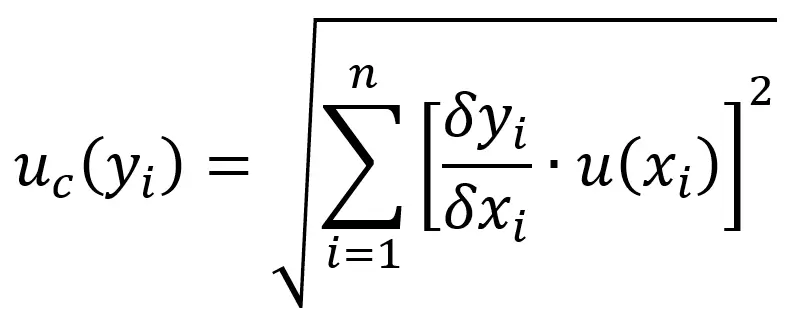
The formula to calculate the combined standard uncertainty is given below:
uc = √(u12 + u22 + un2)
The combined standard measurement uncertainty formula from the JCGM 100:2008 (GUM) is provided below.
How to combine percentage uncertainties?
Percentage uncertainties (i.e. relative uncertainties) are combined in the same manner as absolute uncertainties. First, characterize each uncertainty by assigning an appropriate probability distribution. Next, convert each percentage uncertainty to a standard uncertainty (i.e. standard deviation equivalent). Finally, combined the uncertainties using the RSS method.
The combined standard uncertainty will be a percentage. Typically, relative to the measurand and expressed as a percentage of reading, indicated value, or other similar term.
What is the RSS method of uncertainty?
The RSS method stands for the square root of the sum of squares method.
It is the method used to calculate the combined standard measurement uncertainty, where each standard uncertainty is squared and added together. Then, the square root is calculated from the sum of squared uncertainties.
According to the JCGM 100:2008, it is actually defined as the square root of the total combined variance.
How to combine uncertainties of different units?
Use sensitivity coefficients or relative uncertainties to combine uncertainties with different units of measurement.
Method #1: Sensitivity Coefficients
First, you can use sensitivity coefficients. Sensitivity coefficients can be used to convert uncertainties to the same unit of measurement as the result or measurand. Then, the converted values can be combined using the RSS method.
This makes sensitivity coefficients ideal for calculating the combined standard uncertainty. Plus, they work for any scenario. However, determining sensitivity coefficients can require experimentation or complex evaluations that some people may find difficult.
Method #2: Relative Uncertainties
Otherwise, you can use relative uncertainties. For simple formulas, you can convert the uncertainties to terms relative to the measurand (i.e. percentage or parts per million equivalent). Then, the relative terms can be combined using the RSS method.
This method is popular because it is easy to implement. However, it is not applicable for all scenarios (typically, complex formulas). The rules for the propagation of uncertainty should be carefully followed to avoid errors in estimated uncertainties.
Glossary
- Measurement Uncertainty
- non-negative parameter characterizing the dispersion of the quantity values being attributed to a measurand, based on the information used. (Source: JCGM 200:2012, 2.26)
- Standard Measurement Uncertainty
- measurement uncertainty expressed as a standard deviation. (Source: JCGM 200:2012, 2.30)
- Combined Standard Measurement Uncertainty
- standard measurement uncertainty that is obtained using the individual standard measurement uncertainties associated with the input quantities in a measurement model. (Source: JCGM 200:2012, 2.31)
- Measurand
- quantity intended to be measured. (Source: JCGM 200:2012, 2.3)
- Relative Measurement Uncertainty
- measurement uncertainty expressed in a term relative to the measurand.
- Absolute Measurement Uncertainty
- measurement uncertainty expressed in the same unit of measurement as the measurand.
- Sensitivity Coefficient
- a quotient of the change in an indication of a measuring system and the corresponding change in a value of a quantity being measured. (Source: JCGM 200:2012, 4.12)
- Probability Distribution
- a function or table that describes the likelihood of all possible outcomes for a random variable associated with an experiment or event.