
According to the Vocabulary in Metrology, Type A evaluation of measurement uncertainty is an “evaluation of a component of measurement uncertainty by a statistical analysis of measured quantity values obtained under defined measurement conditions.”
Example
Examples of a Type A uncertainty include:
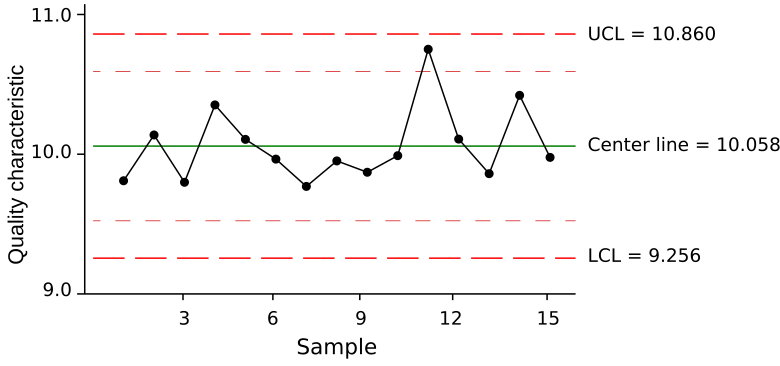
- Repeatability – variation in results under same measurement conditions
- Reproducibility – variation in results under different measurement conditions
- Intermediate Precision – variation in results under same measurement conditions over time
- Stability – variation in results over time
- Calibration Curve Fit – standard error of the estimate for a curve fit prediction model.
FAQ
What’s the difference between Type A (statistical) and Type B (non-statistical) evaluation?
Believe it or not, the answer is in your question.
According to the JCGM 100:2008 and Recommendation INC-1 (1980),
- Type A evaluations are evaluated by statistical methods (e.g. estimated variances)
- Type B evaluations are evaluated by other means (e.g. priori knowledge, assumptions, or arguments).
Type A evaluations use statistical techniques to evaluate uncertainty such as the standard deviation of a series of observations or the standard error of the estimate for a curve fit model.
Type B evaluations determine the uncertainty by means other than statistical techniques such as manufacturer specifications, calibration results, or reference data even if the estimated quantities correspond to variances and are treated like standard deviations.
What are examples of Type A evaluations?
Examples of a Type A uncertainty include:
- Repeatability – variation in results under similar measurement conditions
- Reproducibility – variation in results under different measurement conditions
- Intermediate Precision – variation in results under same measurement conditions over time
- Stability – variation in results over time
- Calibration Curve Fit – standard error of the estimate for a curve fit prediction model.
What are examples of Type B evaluations?
Examples of a Type B uncertainty include:
- Drift – change in value over time.
- Bias – error in value by comparison to a nominal or reference value.
- Linearity – deviation in value from straight line behavior.
- Hysteresis – deviation in value when operating in different directions.
- Resolution – smallest incremental change in a value.
- Reference Standard Uncertainty – uncertainty related to the comparison to a reference standard (i.e. calibration).
- Environmental Effects – uncorrected uncertainties related to environmental conditions and influences.
- Method-Specific Uncertainties – uncertainties related to the method or technique used to perform testing or calibration.
How are Type A and B uncertainties combined?
Type A and Type B uncertainties are converted to a standard deviation equivalents (i.e. standard uncertainty) and combined using the square root of the sum of squares formula (i.e. RSS method) per the JCGM 100:2008.
Glossary
- Measurement Uncertainty
- non-negative parameter characterizing the dispersion of the quantity values being attributed to a measurand, based on the information used. (Source: JCGM 200:2012, 2.26)
- Measured Quantity Value
- quantity value representing a measurement result (Source: JCGM 200:2012, 2.10)
- Measurement Repeatability
- measurement precision under a set of repeatability conditions of measurement (Source: JCGM 200:2012, 2.21)
- Repeatability Condition of Measurement
- condition of measurement, out of a set of conditions that includes the same measurement procedure, same operators, same measuring system, same operating conditions and same location, and replicate measurements on the same or similar objects over a short period of time (Source: JCGM 200:2012, 2.20)
- Measurement Reproducibility
- measurement precision under reproducibility conditions of measurement (Source: JCGM 200:2012, 2.25)
- Reproducibility Condition of Measurement
- condition of measurement, out of a set of conditions that includes different locations, operators, measuring systems, and replicate measurements on the same or similar objects (Source: JCGM 200:2012, 2.24)
- Intermediate Precision
- measurement precision under a set of intermediate precision conditions of measurement (Source: JCGM 200:2012, 2.23)
- Intermediate Precision Condition of Measurement
- condition of measurement, out of a set of conditions that includes the same measurement procedure, same location, and replicate measurements on the same or similar objects over an extended period of time, but may include other conditions involving changes (Source: JCGM 200:2012, 2.22)
- stability of a measuring instrument
- property of a measuring instrument, whereby its metrological properties remain constant in time (Source: JCGM 200:2012, 4.19)