
Short answer: Relative uncertainty is measurement uncertainty divided by the absolute value of the measurement or result so it can expressed in a term relative to the measurand, such as a percentage, parts-per-million, etc.
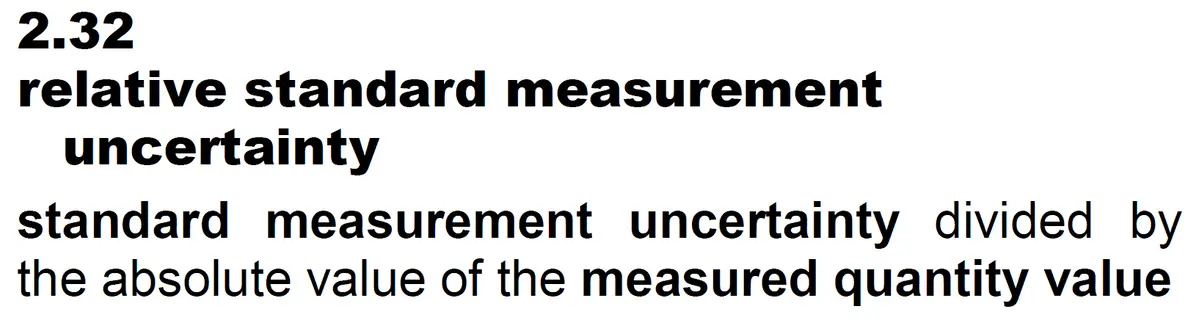
According to the Vocabulary in Metrology (VIM), relative standard measurement Uncertainty is the “standard measurement uncertainty divided by the absolute value of the measured quantity value.”
Measurement uncertainty can be reported in absolute or relative terms. Typically, relative uncertainties are expressed in one of the following terms:
- Percentage (%)
- Part per million
- Parts in 106
- micro unit per unit (µUnit/Unit)
- Part per billion
- Parts in 109
- nano unit per unit (nUnit/Unit)
- Part per trillion
- Parts in 1012
- pico unit per unit (pUnit/Unit)
The most commonly reported forms of relative uncertainty are percentage or part-per-million.
However, according to the report from the 87th meeting of the CIPM ,the use of abbreviations such as “ppm,” “ppb,” “ppt,” or similar should be avoided because they are ambiguous and can be interpreted (internationally) to have different meanings. Furthermore, the ILAC P14 policy also prohibits the use of these abbreviations for CMC uncertainty expressed in calibration laboratory scopes of accreditation.
Example
Here are some common examples of relative uncertainty.
Example 1: Lead (Pb) concentration of a sample using ICP-MS
10.00 µg/L ± 8.7 %
Example 2: Length measured with a universal measuring machine
100.000000 mm ± 0.51 µm/m
Example 3: Voltage measured with an 8.5-digit digital multimeter
10.00000 V ± 4.7 µV/V
Example 4: Pressure measurement performed with a dead weight tester
100.0000 psig ± 15 parts in 106
Example 5: Frequency generated by a GPS Disciplined Oscillator
10.00000000000 MHz ± 10 pHz/Hz
FAQ
How to calculate relative standard uncertainty?
Calculate relative uncertainty by dividing the absolute uncertainty by the absolute value of the measurand. For example, a 100 µL pipette with an absolute uncertainty of 0.58 µL could be expressed as a relative uncertainty using the formula: 0.58 µL / 100 µL x 100 = 0.58 %.
What is the difference between relative and absolute uncertainty?
Relative uncertainty is expressed in a term relative to the measurand (e.g. percent, part-per-million, etc) while absolute uncertainty is expressed in the same unit of measurement as the measurand.
How to calculate RSD in chemistry?
In chemistry, RSD is typically expressed as a percentage. To calculate it, first calculate the standard deviation. Next, divide the standard deviation by the absolute value of the result (typically, a concentration). Multiply the result by 100 to get RSD as a percentage.
If RSD needs to be expressed as an expanded uncertainty, determine the desired level of confidence (Typically, 95.45 %). Next, calculate the degrees of freedom and use the t-distribution to find the coverage factor. Then, multiple the percent RSD by the coverage factor.
What is the difference between relative uncertainty and relative standard deviation?
Relative standard uncertainty and relative standard deviation have similar confidence intervals. Both represent a standard deviation with a 68.27 % confidence interval. If either one is to be expressed as an expanded uncertainty (i.e. JCGM 100:2008, ISO 21748, or ISO 19036), they need to be multiplied by a coverage factor that produces a desired level of confidence.
However, relative uncertainty and relative standard deviation can have different confidence intervals. For example, a relative uncertainty can represent an expanded uncertainty with a 95.45 % confidence interval while a relative standard deviation represents a standard deviation with a 68.27 % confidence interval.
What is the difference between relative and absolute accuracy?
According to Fluke and Transmille equipment specifications, absolute accuracy contains all sources of error including the uncertainty of the calibration reference standard while relative accuracy contains all sources of error except the uncertainty of the calibration reference standard. The absolute accuracy is recommended for use if the equipment is calibrated by the respective manufacturer’s calibration facilities while the relative accuracy should be used in combination with the reference standard uncertainty if the equipment is calibrated by a laboratory other than the manufacturer.
What is relative standard uncertainty?
Relative standard uncertainty is a standard deviation of standard uncertainty expressed in relative terms, such as percentage, part-per-million, or equivalent.
Glossary
- Measurement Uncertainty
- non-negative parameter characterizing the dispersion of the quantity values being attributed to a measurand, based on the information used. (JCGM 200:2012, 2.26)
- Measurand
- quantity intended to be measured. (JCGM 200:2012, 2.3)
- Absolute Measurement Uncertainty
- measurement uncertainty expressed in the same unit of measurement as the measurand.
- CMC Uncertainty
- calibration and measurement capability uncertainty available to customers under normal conditions as described in a laboratory’s scope of accreditation or published in the BIPM key comparison database (KCDB). (ILAC P14:09/2020)