
Short answer: measurement uncertainty expressed as an absolute value and in the same unit of measurement as the measurand. Many ISO/IEC 17025 accredited laboratories report measurement uncertainty as an absolute uncertainty in their reports and, where applicable, scopes of accreditation.
Measurement Uncertainty Reporting Requirements
In fact, accredited laboratories must present measurement uncertainty in the same unit as the measurand or in a term relative to the measurand. Below, is a list of the relevant requirements:
- ISO/IEC 17025 section 7.8.3.1c requires test laboratories, where applicable, to report measurement uncertainty as an absolute or relative uncertainty.
- ISO/IEC 17025 section 7.8.4.1a requires calibration laboratories to report measurement uncertainty as an absolute or relative uncertainty.
- ILAC P14, section 4.3 requires calibration laboratories to report measurement uncertainty in their scopes of accreditation as an absolute or relative uncertainty.
- ILAC P14, section 5.6 requires calibration laboratories to report measurement uncertainty in their calibration reports as an absolute or relative uncertainty.

Absolute Uncertainty Reporting Formats
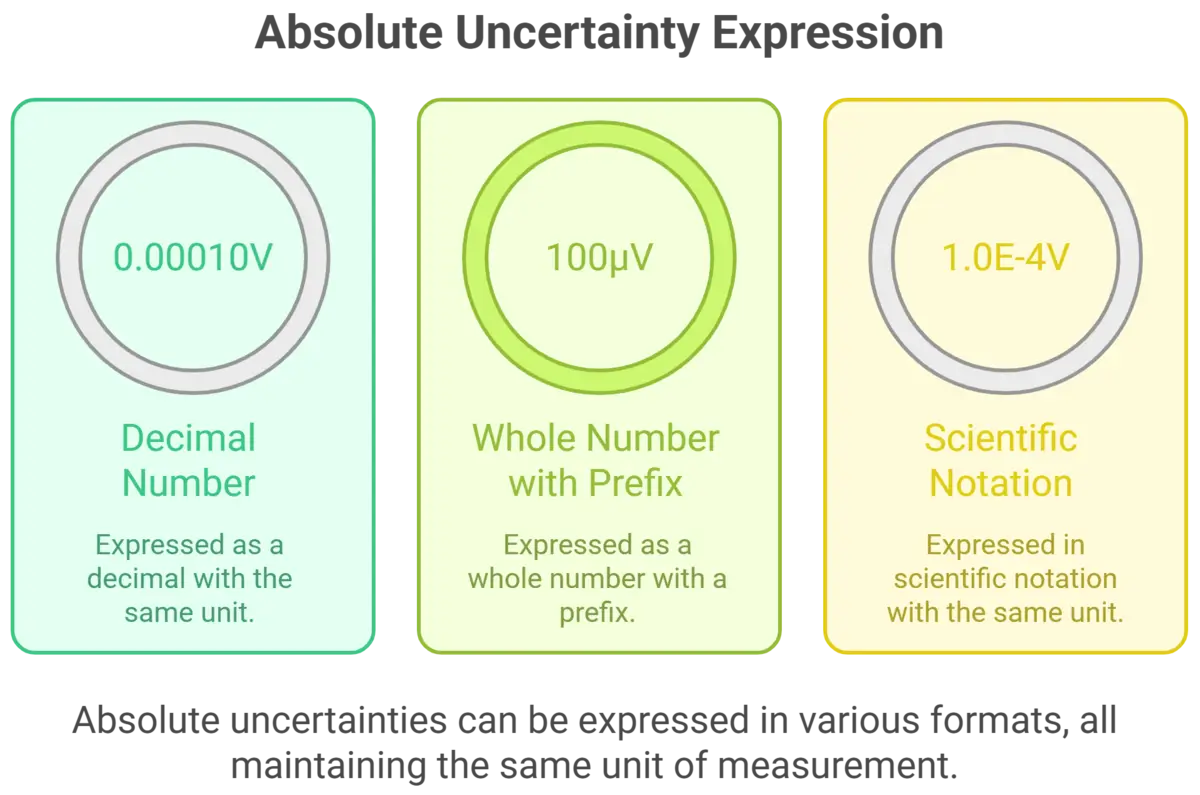
Typically, absolute uncertainties are expressed as:
- Decimal number with same unit of measurement (e.g. 0.00010 V),
- Whole number with same unit of measurement and prefix (e.g 100 µV), or
- Scientific notation with same unit of measurement (e.g. 1E-04 V).
However, be careful. Some measurement results and their associated uncertainties are reported as a percentage. Do not confuse this for a relative uncertainty. Instead, it would be an absolute uncertainty since the result and uncertainty are in the same unit of measurement.
Examples of Reporting Absolute Uncertainty
Here are some common examples of relative uncertainty.

Example 1: Lead (Pb) concentration of a sample using ICP-MS
- 10.00 µg/L ± 0.87 µg/L
Example 2: Length measured with a universal measuring machine
- 100.000000 mm ± 0.000051 mm
- 100.000000 mm ± 51 µm
- 100.000000 mm ± 5.1E-05 mm
Example 3: Voltage measured with an 8.5-digit digital multimeter
- 10.00000 V ± 0.00047 V
- 10.00000 V ± 47 µV
- 10.00000 V ± 4.7E-06 V
Example 4: Relative Humidity measured with a hygrometer
- 50.00 %RH ± 0.50 %RH
FAQ
What is relative uncertainty?
Relative uncertainty is measurement uncertainty divided by the absolute value of the measurement or result so it can expressed in a term relative to the measurand, such as a percentage, parts-per-million, etc.
How to calculate relative standard uncertainty?
Calculate relative uncertainty by dividing the absolute uncertainty by the absolute value of the measurand. For example, a 100 µL pipette with an absolute uncertainty of 0.58 µL could be expressed as a relative uncertainty using the formula: 0.58 µL / 100 µL x 100 = 0.58 %.
How to convert relative uncertainty to an absolute uncertainty?
Convert relative uncertainty to absolute uncertainty by multiplying the measurand by the relative uncertainty. For example, a 100 µL pipette with an relative uncertainty of 0.58 % can be converted to an absolute uncertainty using the formula: 100 µL x 0.58 % = 0.58 µL
How to report absolute uncertainty?
Report absolute uncertainty as an expanded uncertainty rounded to two significant digits in the same unit as the measurand, same unit of measurement with a prefix, or in scientific notation.
What is the difference between relative and absolute accuracy?
According to Fluke and Transmille equipment specifications, absolute accuracy contains all sources of error including the uncertainty of the calibration reference standard while relative accuracy contains all sources of error except the uncertainty of the calibration reference standard. The absolute accuracy is recommended for use if the equipment is calibrated by the respective manufacturer’s calibration facilities while the relative accuracy should be used in combination with the reference standard uncertainty if the equipment is calibrated by a laboratory other than the manufacturer.
Glossary
- Measurement Uncertainty
- non-negative parameter characterizing the dispersion of the quantity values being attributed to a measurand, based on the information used. (JCGM 200:2012, 2.26)
- Measurand
- quantity intended to be measured. (JCGM 200:2012, 2.3)
- Relative Measurement Uncertainty
- measurement uncertainty expressed in a term relative to the measurand.
- Absolute Measurement Uncertainty
- measurement uncertainty expressed in the same unit of measurement as the measurand.
- CMC Uncertainty
- calibration and measurement capability uncertainty available to customers under normal conditions as described in a laboratory’s scope of accreditation or published in the BIPM key comparison database (KCDB). (ILAC P14:09/2020)